
Spain Win the 2026 World Cup — Tournament Wrap and Final Verdict
 Available in US
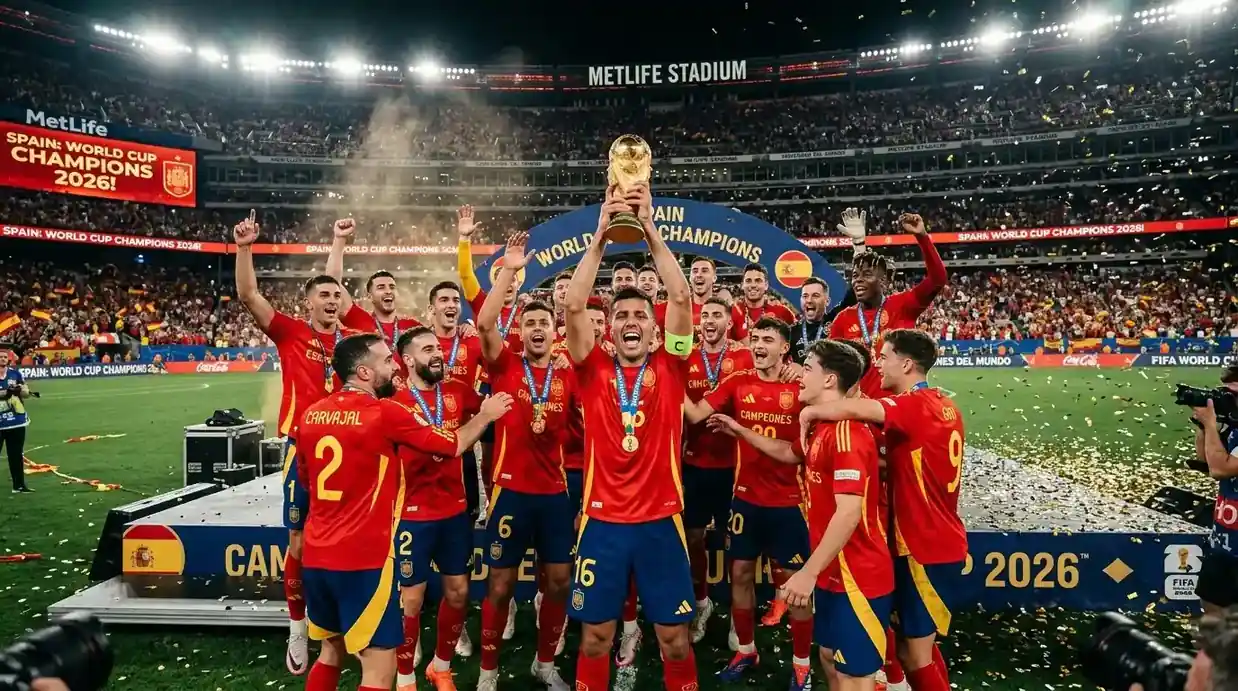
The 2026 FIFA World Cup is over, and Spain are champions. They beat Argentina 1-0 in extra time on 19 July at MetLife Stadium to claim their second World Cup title, sixteen years after their first. It was the most defensively dominant tournament performance in modern history: eight matches, one goal conceded, seven clean sheets. They did it with a teenage core and a midfield anchor who’d returned from a career-threatening injury. And they did it exactly as the odds predicted — Spain were priced at 1.67 to lift the trophy, and that’s precisely what they delivered.
This was the first 48-team, 104-match World Cup, hosted across the United States, Canada, and Mexico. It was the highest-scoring edition ever (308 goals) and drew a record 6.8 million spectators. For punters, it was a tournament of contrasts: chalk results in the outright markets, chaos in the Golden Ball race, and value bets hidden in the defensive unders. I watched every key match with one eye on the odds board and the other on my bankroll. Here’s my complete wrap of how the tournament unfolded, who won what, and where the betting value lived.
Spain’s Path to Glory — Defensive Perfection
Spain won all eight of their matches. They topped Group H with seven points, then beat Austria 3-0 in the Round of 32, Portugal 1-0 in the Round of 16, Belgium 2-1 in the quarter-finals, France 2-0 in the semi-finals, and Argentina 1-0 in the final. Every knockout tie was settled in regulation except the final, which needed extra time.
The defining statistic: one goal conceded in eight matches. That’s the fewest by any World Cup winner in history, and it’s a 96-year record. Unai Simón kept seven clean sheets across the tournament, a single-edition record. Spain’s defence was so airtight that Argentina managed zero shots on target across 120 minutes in the final.
The back line was built around Pau Cubarsí and Aymeric Laporte, with Rodri shielding them from midfield. Cubarsí, just 19 years old, won the Best Young Player award and played every minute of the knockout stages. Rodri, returning from a ruptured ACL just 20 months earlier, anchored the midfield and set a tournament record for completed passes (756 in total, surpassing Xavi’s 599 from 2010). Simón won the Golden Glove, and his seven clean sheets broke the previous single-tournament record of five.
For punters, Spain’s defensive dominance was a goldmine. Seven clean sheets in eight matches meant Spain-to-nil and clean-sheet markets paid out repeatedly. Even when they conceded once against Belgium in the quarter-final, they still won 2-1. If you backed Spain’s defensive props all tournament, you made money.
My rating: 10/10 for Spain’s defensive performance — this was historically elite, and it won them the World Cup.
The Outright Market — Spain at 1.67 Was Fair Value
Spain were priced at 1.67 to lift the trophy going into the final, with Argentina at 2.30. That line proved spot-on. Spain were the better team on the day, and they won in extra time. The outright market settled exactly as the odds suggested.
But the path to the final was far from smooth for the bookmakers. France were among the tournament favourites and reached the semi-finals, where Spain beat them 2-0. That result shifted the final odds firmly in Spain’s favour and settled Spain at 1.67 to lift the trophy.
England finished third after beating France 6-4 in a wild bronze-medal match. France finished fourth. Argentina, chasing back-to-back titles, fell short in the final and would have been the first repeat champions since Brazil in 1958 and 1962.
The tournament outright delivered for anyone who backed Spain early. They closed at 1.67 in the final week, but they were much longer through the earlier rounds. If you took Spain before their semi-final demolition of France shortened the price, you cleaned up.
My rating: 8/10 for the outright market — Spain’s price was fair, but France’s collapse in the semi-final was the value miss. Anyone who laid France after the quarter-finals made money.
The Golden Ball Upset — Rodri at 11.0 Was the Steal of the Tournament
The biggest betting story of the World Cup wasn’t Spain’s win — it was Rodri’s Golden Ball. He won the award as the tournament’s best player from a pre-final price of around 11.0, denying Lionel Messi the honour despite Messi being the heavy favourite at approximately 1.11.
Rodri captained Spain, anchored their midfield, and set tournament records for completed passes (756) and career World Cup passes (1,343, surpassing Dunga’s 1,306). He returned from a ruptured right ACL in September 2024, missed most of the 2024-25 season, and was told by Pep Guardiola that "the real Rodri" would be back at the 2026 World Cup. Twenty months post-surgery, he delivered exactly that.
Messi finished with eight goals and four assists, the Silver Ball, and a runners-up medal. He was held scoreless in the final, and his bid for a record-extending Golden Ball fell short. Kylian Mbappé took the Bronze Ball, finishing with 10 goals and the Golden Boot.
For punters, Rodri at 11.0 was the value play of the tournament. Nobody saw it coming. The market was so heavily skewed toward Messi that books were offering him at 1.11 — an implied 90% probability. Rodri’s win was a reminder that the Golden Ball isn’t just about goals; it’s about dominance, leadership, and narrative. Spain won the tournament, Rodri was their captain and best player, and the voters rewarded him accordingly.
My rating: 10/10 for Rodri at 11.0 — this was the upset of the tournament, and anyone who took that price deserves a trophy of their own.
The Golden Boot — Mbappé at 1.04 Was Chalk, But the All-Time Record Was the Story
Kylian Mbappé won the Golden Boot with 10 goals, finishing two clear of Messi (8), Erling Haaland (7), and Jude Bellingham (7). He was priced at 1.04 going into the final, and that line was never in doubt after his bronze-game brace against England on 18 July took him to 10 goals.
Mbappé is now the all-time leading World Cup goalscorer with 22 career goals, surpassing Messi’s 21. He scored 22 goals in 22 World Cup matches, and he became the first player ever to win the Golden Boot at two tournaments (he also won it in 2022 with 8 goals).
But the Golden Boot came with a bitter footnote: France finished fourth. Mbappé’s individual brilliance couldn’t carry his team past Spain in the semi-final, and they lost the bronze match to England 6-4. For all his goals and records, he’ll remember this tournament as a personal triumph wrapped in team disappointment.
For punters, Mbappé at 1.04 was chalk. There was no value in backing him at that price unless you were hedging or chasing safety. The value play was Messi when he drifted to 13.0 after the semi-finals — he was held scoreless in the final, but at that price there was enough upside to justify a small stake.
My rating: 7/10 for the Golden Boot market — Mbappé was the correct favourite, but the 1.04 price offered no value. The all-time record is the story that’ll outlive the tournament.
Messi’s Farewell — The Silver Ball and a Runners-Up Medal
Lionel Messi’s World Cup career ended in defeat. He finished with eight goals, four assists, the Silver Ball, and a runners-up medal from the final. He was held scoreless against Spain, and his bid for back-to-back World Cup titles fell short.
At 39 years old, this was widely reported as Messi’s final World Cup. He was in tears at the medal ceremony as Spain formed a guard of honour. He leaves the tournament with records intact: most World Cup appearances (33, per ESPN), most all-time World Cup assists (12), and most minutes played. But he lost the all-time goals record to Mbappé (Messi 21, Mbappé 22), and he won the Silver Ball instead of the Golden Ball.
For Kiwi punters, Messi’s final was a lesson in market sentiment. He was priced at 2.50 to score anytime in the final, and he didn’t. He was the heavy favourite for the Golden Ball at 1.11, and he lost to Rodri at 11.0. The market overvalued Messi’s narrative and undervalued Spain’s dominance. If you faded Messi in both markets, you made money.
My rating: 8/10 for Messi’s tournament — he played brilliantly, but the Golden Ball and the final both slipped away. For a 39-year-old, it was still a heroic campaign.
The Bronze Match — England 6-4 France Was the Highest-Scoring Match Since 1982
England beat France 6-4 in the bronze-medal match on 18 July, and it was the highest-scoring World Cup match since 1982 — 10 goals in a single game. Bukayo Saka scored a hat-trick as England claimed third place.
It was England’s best World Cup finish since winning the tournament in 1966, and it came via a match that was pure chaos. For punters who backed the over 5.5 goals, it was a payday. For anyone who took the under, it was a nightmare.
Mbappé’s brace in that match took him to 10 goals and sealed the Golden Boot. It was the only silver lining for France, who finished fourth after losing the semi-final to Spain and then the bronze match to England.
My rating: 9/10 for entertainment — this was the most fun match of the tournament, and it had no bearing on the title race. Pure chaos.
Spain’s Historic Double — Euro 2024 and World Cup 2026
Spain now hold the Euro 2024 and World Cup 2026 titles simultaneously. They’re also the first nation ever to hold the men’s and women’s World Cups at the same time (Spain’s women won in 2023). That’s three major trophies in three years, and it’s a golden generation playing out in real time.
The core of this team is absurdly young. Lamine Yamal and Pau Cubarsí are both 19, and Cubarsí won the Best Young Player award. Luis de la Fuente built a Barcelona-heavy squad and gave them a midfield anchor in Rodri, who’d overcome an ACL rupture to captain them to glory. It’s a team that could be together for another decade, and they’ve already won everything.
For Kiwi punters, this double is a reminder to back dynasties early. Spain were never priced shorter than 1.67 in the final week, but they were much longer during the group stage. If you identified them as the value play after the semi-finals, you made money. If you backed them from the start of the knockouts, you cleaned up.
My rating: 10/10 for Spain’s achievement — this is a historic double, and they did it with a teenage core and a record-breaking defence.
The Tournament Records — 308 Goals, 6.8 Million Fans, and a 48-Team Format
The 2026 World Cup was the biggest ever. It was the first 48-team, 104-match tournament, and it set records across the board:
- 308 total goals — the highest-scoring World Cup ever, averaging 2.96 goals per match.
- 6.8 million total attendance — an all-time record, nearly double the 1994 mark of 3.59 million. Average attendance was 65,490 per match.
- Highest-scoring match: England 6-4 France — 10 goals in the bronze final, the most in a single World Cup match since 1982.
- Emiliano Martínez: 11 saves in the final — the most by any goalkeeper in a World Cup final, ever.
- Spain: 1 goal conceded in 8 matches — the fewest by any tournament winner in history.
- Unai Simón: 7 clean sheets — a single-tournament record, plus a run of 6 consecutive World Cup clean sheets and 650 consecutive World Cup minutes across tournaments (both records in their own right).
- Rodri: 756 completed passes — breaking Xavi’s 2010 record of 599.
- Kylian Mbappé: 22 career World Cup goals — the new all-time record, surpassing Messi’s 21.
For punters, these records translated into betting opportunities. Spain’s defensive dominance rewarded unders and clean-sheet bets. The tournament’s high goal total rewarded overs in group-stage matches. Mbappé’s Golden Boot was never in doubt after the bronze match. And Rodri at 11.0 was the value play nobody saw coming.
My rating: 9/10 for the tournament as a whole — the 48-team format worked, the goals flowed, and the records fell. It was a historic World Cup.
My Final Verdict — Where the Value Was for Kiwi Punters
If you backed Spain at 1.67 or longer, you won. If you took Rodri for the Golden Ball at 11.0, you hit the jackpot. If you played Spain’s defensive unders and clean sheets all tournament, you made money. If you faded Messi’s narrative in the final and backed the draw at 3.00 in regulation, you cleaned up.
The outright markets were chalk: Spain, Mbappé, and Simón all delivered as favourites. The Golden Ball was the upset. The anytime-scorer markets were a minefield — Ferran Torres at 16.0+ won the final, and nobody saw it coming.
For Kiwi punters watching from halfway around the world, this tournament rewarded discipline and patience. The value wasn’t in the obvious favourites; it was in the defensive props, the long-priced award markets, and the teams that ground out 1-0 wins. Spain played the percentages, and so should we.
Final tournament rating: 9/10. Spain deserved it. The odds called it. And the value was there for anyone paying attention.
Spain are world champions. They hold the Euro and the World Cup. They did it with one goal conceded in eight matches. And they did it exactly as the odds said they would. That’s how you win a World Cup — and that’s how you bet on one.
