
Spain 1-0 Argentina: World Cup Final Recap — Ferran Torres Decides It in Extra Time
 Available in US
Spain are world champions. A 1-0 victory over Argentina in extra time at MetLife Stadium on 19 July delivered La Roja their second World Cup title, and capped the most miserly defensive campaign in tournament history. For 106 minutes the final was scoreless; then substitute Ferran Torres finished a Nico Williams header to settle the match. Argentina, chasing back-to-back titles, fell short — and did so with ten men after Enzo Fernández saw red in the dying minutes of regulation.
I watched this match with one eye on the odds board and the other on the clock. The 90-minute 1X2 settled on the draw — exactly as the 2.95–3.00 price suggested it might. Spain’s 1.67 to lift the trophy proved bang-on, but only after 120 minutes of graft. For punters who backed the regulation draw or the under 2.5 goals, it was a profitable evening. For those who laid Ferran Torres as an anytime scorer at 16.0+, it was a brutal one.
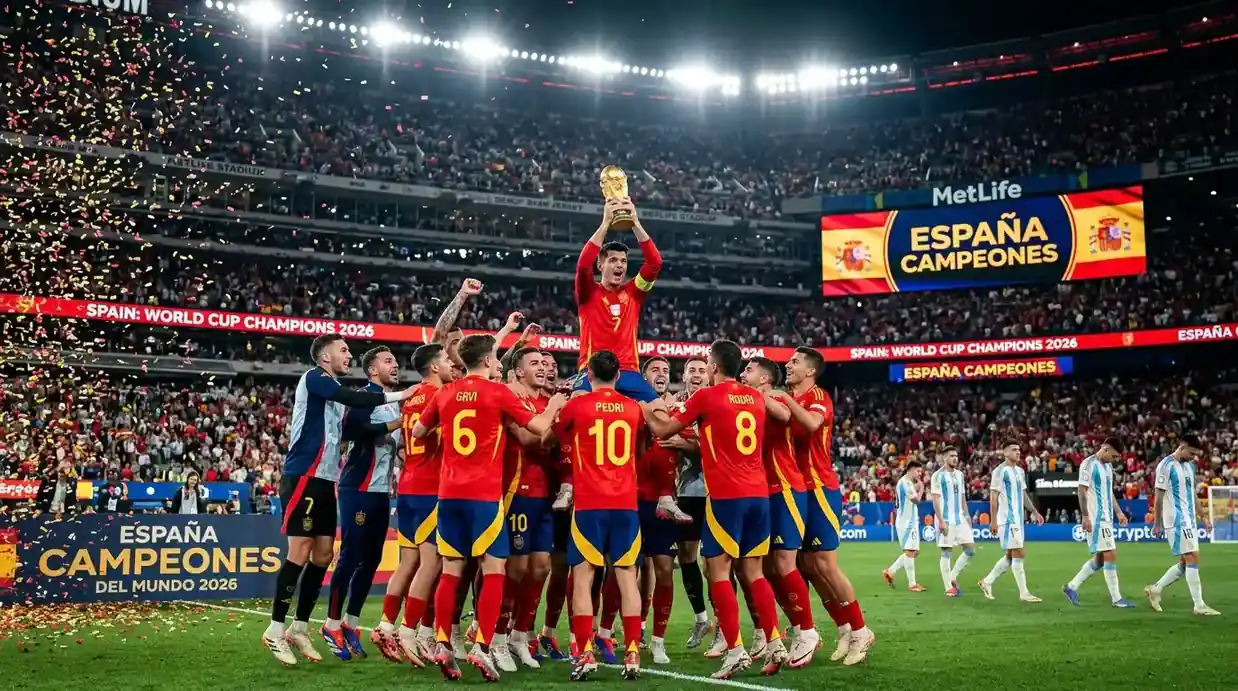
The Goal That Won the World Cup — 106th Minute
Spain broke the deadlock 39 seconds into the second half of extra time. Pedro Porro delivered to the back post, where Nico Williams — himself a substitute — won the header. The ball dropped to Ferran Torres, who finished first-time with his left foot past Emiliano Martínez. Two substitutes combined for the World Cup-winning goal.
Torres had come on in the 62nd minute for Mikel Oyarzabal. He’d been a rotation name all tournament, unlisted in the pre-match anytime-scorer markets at most bookmakers. When his shot hit the net, it was a longshot payout for the handful who’d taken him at 16.0 or longer. For the rest of us, it was a reminder that World Cup finals are settled by the margins — and that Luis de la Fuente’s depth chart ran deeper than Argentina’s.
The goal itself was clinical. Porro’s delivery was measured, Williams’ movement intelligent, Torres’ finish composed. Argentina’s defence, which had held firm for 105 minutes, simply ran out of time and numbers.
My rating: 8/10 for the goal as a bet-settling moment — it rewarded Spain’s territorial dominance and came from exactly the kind of substitute-driven sequence that punters overlook when they back the obvious names.
Argentina Down to Ten — Enzo Fernández Sent Off
Enzo Fernández received his second yellow card in the 90+3rd minute for a reckless foul on Pau Cubarsí, leaving Argentina to play extra time with ten men. The challenge sent Cubarsí airborne; the referee showed the second yellow without hesitation. ESPN’s laws desk judged the red card deserved.
Playing a man down for 30 minutes of extra time is a near-impossible task in a World Cup final. Argentina did their best to absorb pressure, but Spain’s numerical advantage eventually told. The Fernández dismissal didn’t directly create the winning goal, but it tilted the final 15 minutes firmly in Spain’s favour.
There was a post-match flashpoint as well. Seconds after the final whistle, Leandro Paredes grabbed Spain’s Eric García by the throat and wrestled Gavi to the ground. Several outlets reported that Paredes was sent off, but FIFA’s official match report says he was not. The altercation is confirmed; the red card is disputed. Either way, it was an ugly end to Argentina’s campaign.
My rating: 6/10 for Argentina’s discipline — the Fernández red was avoidable, and the post-whistle scenes were unnecessary. They competed hard, but lost their heads when it mattered.
Emiliano Martínez — 11 Saves, Still Not Enough
Emiliano Martínez made 11 saves in the final — the most by any goalkeeper in a World Cup final, ever. He was reportedly playing through a broken finger. Without him, this match would have been settled long before extra time.
Spain peppered his goal for 106 minutes, and Martínez kept them out time and again. He held his line on crosses and made save after save as Spain pressed. For 106 minutes, he kept Argentina in the match singlehandedly.
But in the end, one lapse — the Torres goal — was all it took. Martínez’s tournament performance will be remembered as heroic, but it wasn’t enough to deliver Argentina a second consecutive title.
My rating: 10/10 for Martínez individually — the saves record speaks for itself. He played through injury and kept his team in the match until the numbers game caught up with them.
Spain’s Defence — One Goal Conceded in Eight Matches
Spain won the World Cup by conceding just one goal in eight matches — the fewest ever by a tournament winner. They kept seven clean sheets, including the final. Argentina managed zero shots on target across 120 minutes.
This was a defensive masterclass that started in the group stage and never wavered. Pau Cubarsí and Aymeric Laporte were imperious at the back; Rodri shielded them in midfield; Unai Simón made the saves he needed to make. The back line conceded just once across the entire tournament — a single goal in the quarter-final win over Belgium.
For punters, Spain’s defensive record was a goldmine. Seven clean sheets in eight matches meant Spain-to-nil and clean-sheet markets paid out again and again — they conceded only once all tournament. Even the final, which went 0-0 after 90 minutes, rewarded those who backed the draw or the under.
My rating: 10/10 for Spain’s defence — this was a 96-year record, and it won them the World Cup.
The Odds Board — How the Lines Settled
The closing lines for the final told the story. Spain were priced around 1.67 to lift the trophy, with Argentina at 2.30. The 90-minute 1X2 had Spain at 2.25–2.30, the draw at 2.95–3.00, and Argentina at 3.60.
The match went 0-0 after 90 minutes, so the regulation 1X2 settled on the draw — a winner for anyone who took the 3.00 price. Spain’s 1.67 to lift the trophy (including extra time and penalties) proved accurate, but only after 120 minutes.
The anytime-scorer market was a bloodbath. Lionel Messi was listed at 2.50, Mikel Oyarzabal at 2.60, Lamine Yamal at 3.30. None of them scored. Ferran Torres, unlisted at most books and priced at 16.0+ where available, was the only goalscorer. It was a longshot result that reminded us why World Cup finals are so hard to call.
The Golden Boot market had already been decided the day before. Kylian Mbappé finished on 10 goals after his bronze-game brace; Messi was held scoreless in the final and finished on 8. Mbappé was priced at 1.04 going into the final, and duly delivered.
My rating: 7/10 for the odds board — Spain’s price was fair, the draw was underrated, and the anytime-scorer market was a minefield. The books got the outright right but missed the path Spain took to get there.
What the Final Means for the Tournament Outrights
Spain’s victory settled the outright market at 1.67, exactly where it was priced. Argentina’s defeat ended their bid for back-to-back titles — they would have been the first repeat champions since Brazil in 1958 and 1962.
The Golden Ball market, however, was the upset. Rodri won it from a 11.0 outsider price, denying Messi the award despite Messi being the pre-final favourite at around 1.11. Mbappé took the Bronze Ball, and the Golden Boot at 1.04, while Unai Simón claimed the Golden Glove at 1.13.
Every outright market except the Golden Ball delivered the favourite. For punters, that meant Spain’s win was profitable but not surprising. The Rodri upset was the only major shock.
My rating: 8/10 for how the tournament settled — Spain’s dominance was forecast by the odds, but Rodri’s Golden Ball at 11.0 was the value play nobody saw coming.
My Honest Verdict
Spain deserved this. They were the best team in the tournament by every measure: fewest goals conceded, most clean sheets, longest unbeaten run. They beat Portugal, Belgium, France, and Argentina on their way to the title. They did it with a teenage core — Lamine Yamal and Pau Cubarsí are both 19 — and a midfield anchor who’d returned from an ACL rupture 20 months earlier.
Argentina gave everything, but they were second-best on the day. Martínez’s 11 saves kept them in the match, but the red card and the numerical disadvantage killed their chances. Messi’s final World Cup ended in defeat and a Silver Ball. It’s a cruel sport.
For Kiwi punters, this final was a lesson in discipline. The books priced Spain correctly at 1.67, and the draw at 3.00 was the value play. The anytime-scorer market was a lottery, and Ferran Torres at 16.0+ was the winning ticket. If you backed Spain to lift and the under 2.5 goals, you walked away profitable.
Final rating: Spain 9/10, Argentina 7/10, the final as a spectacle 7/10.
Spain are world champions. They hold the Euro 2024 and World Cup 2026 titles simultaneously, and — with the women’s 2023 crown — they’re the first nation ever to hold the men’s and women’s World Cups at the same time. That’s history. And it was written by a substitute named Ferran Torres in the 106th minute at MetLife Stadium.
